“But whatever house you enter, first say, Peace to this house” Luke 10:5.
On August 7, 2026, I blessed the new house of Solangel Lopez, a teacher at the main preschool in La Caramuca. Our rite of house blessing begins with the reading of Luke 10:5, which is the New Testament basis for it. The concept of invoking God’s blessing on a house is also found in the Old Testament (Genesis 39:5; Ezekiel 44:30). The blessing of a house is often done during the Epiphany season (because the Magi visited the Christ Child in a house, not a stable, Matthew 2:1-12), so there is a Epiphany version of this rite. In any case, the house blessing involves a procession through the house with a Scripture reading and prayer for each room.The context of Luke 10:5 is the “sending of the seventy”. In Luke 9:1-6, our Lord sends the 12 men who He selected as His apostles on their first evangelistic mission, an episode also recorded in Matthew 10:5-15 and Mark 6:7-13. St. Luke is the only evangelist to record the second sending of seventy disciples in the wider sense, other men who accompanied Him in His earthly ministry. “The principal difference between the work of the two groups,” notes Paul E. Kretzmann in his “Popular Commentary”, “seems to have been that the seventy had only a temporary commission, the work ofde preparing the way for Him in parts of Palestine, in Judea, where the Lord was comparatively unknown. Jesus, sent them two by two, for companionship and mutual assistance. They went before His face, as special heralds, to prepare the people for the appearance of the Christ. He mapped out His itinerary and had them take note of the cities and places where He planned to go. It may not have been the intention of Christ to visit all the small villages and hamlets personally, but He wanted the announcement to go before Him that the great Prophet of Galilee, the Savior of Israel, was drawing near to their country.”
It has also been suggested that, as our Lord chose 12 apostles to represent the 12 patriarchs of Israel (the sons of Jacob), the seventy represent either the seventy elders appointed by Moses to help him in his work of teaching and judging the people (Numbers 11:16), or the seventy nations descended from the sons of Noah in Genesis 10. The first interpretation would emphasize that the missionary commission of Matthew 28:19-20; Mark 16:14-15; Luke 24:47-49 was not narrowly given to the apostles, but to the whole church. The second would affirm that the Gospel is for all nations, although it was first given to the Jews. At any rate, there is an evangelistic intent on invoking the Lord’s peace upon visiting a home.
The house blessing is also an invitation to maintain the home as a place where the Scriptures are read and prayers are offered in the name of Jesus. This is the way the home will remain a refuge where members of the family may find protection from the evil influences of the world.
The Christian home as a house of prayer
We continued the theme of the Christian home as a house of prayer in our study of the Lord’s Prayer in Luther’s Large Catechism with the members of Corpus Christi Lutheran Church in Barinas on August 22, 2026. We met in the home of Carmen Linares, because heavy rain flooded the street and made it difficult for everyone to reach the church.
The section on the Lord’s Prayer in the Small Catechism, of course, is subtitled “As the head of the household should teach it in a simple way to his household.” The introduction to the Lord’s Prayer in the Large Catechism and explains how it is linked to the Ten Commandments and the Apostle’s Creed: “We have now heard what we must do and believe, in which things the best and happiest life consists. Now follows the third part, how we ought to pray.” The Lord’s Prayer provides not only a model for our personal petitions, but also a prayer we can remember in times of desperation and in our final hours when our minds are no longer sharp.
We talked about how the first petition, “Hallowed by Thy name,” is a positive restatement of the Second Commandment, “Do not take the name of the Lord your God in vain.” We can teach our children to keep God’s name holy by praying and reading the Scriptures. We were treated to a example of this as a boy named Lucas recited the Ten Commandments from memory, as his mother, Lusveidis, a teacher, taught him.
Latest shipment of medicine
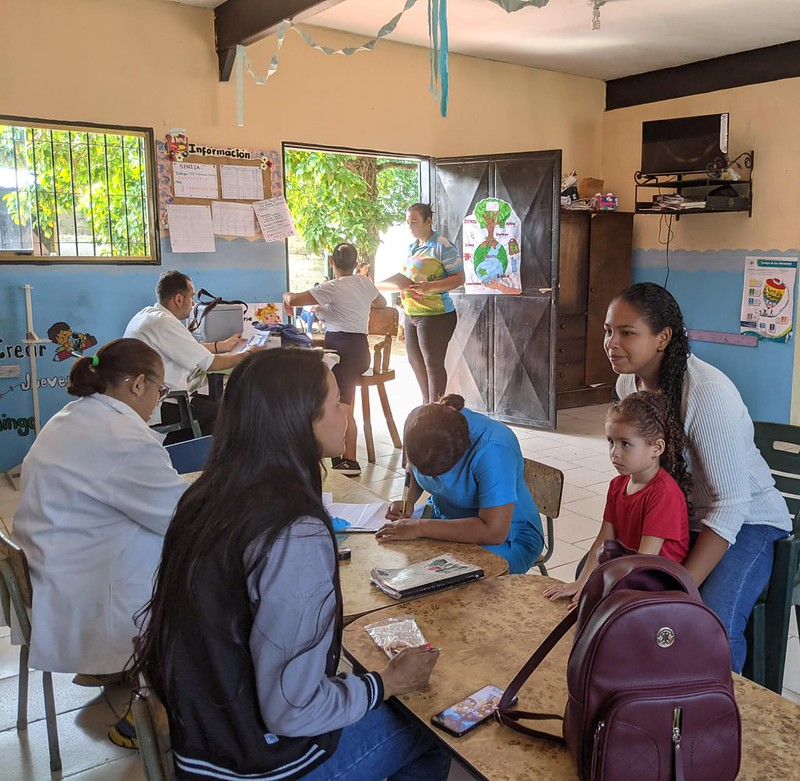
We distributed the latest shipment of non-prescriptions from GLO Chile at Epiphany Lutheran Mission of La Caramuca and Corpus Christi Lutheran Church in Barinas. Global Lutheran Outreach has expanded its Venezuela relief program to include help for earthquake victims, as well as continuing the shipment of non-prescription medicines from Chile. To find out more, please visit the GLO earthquake relief page.
“For our citizenship is in heaven, from which we also eagerly wait for the Savior, the Lord Jesus Christ” (Philippians 3:20).
I would like to begin 2026 by assuring all our family, friends and supporters that Luz Maria and I are safe and sound and continuing our ministry in Venezuela. My resident visa has been renewed until 2030, a necessary first step toward naturalization, a course I intend to pursue this year. I meet all the requirements for dual citizenship, although I really had not thought about applying until I read about the new Pope being a citizen of both the USA and Ecuador. Dual citizenship represents the best option for me in view of travel restrictions and political instability throughout the world, and it better reflects the commitment I have made to Luz Maria and our work together. About 76% of nations now permit dual citizenship (vs. 33% in 1960), which has become a strategic tool for mobility, security, and diversification.
Always bearing in mind Philippians 3:20, in which St. Paul reminds the Christians of Philippi, a prominent Roman colony whose inhabitants enjoyed the prized status of Roman citizenship, that our highest allegiance is to Jesus as members of the kingdom of God’s grace through baptism. Nevertheless, this citizenship (πολίτευμα) does not make Christians laws unto themselves (Roman 13:1-7). Rather, we live in accord with the laws of whatever land where are placed, whether by birth or adoption, to the extent that those conform with the revealed will of God.
Join our online Mission Circle
Thank you to everyone who has been praying for us and for Venezuela. I have created a WhatsApp group, CÍrculo de Misión "La Epífanía", where can leave your prayers and peitions. You can leave an audio message if you like, as I intend to incorporate these into a periodic devotional podcast.
Strategic planning for Barinas
On Saturday, January 24, 2026, we received a vist from Pastor Eliezer Mendoza, our counselor for the Western Zone of the Lutheran Church of Venezuela (which consists of three congregations). Eliezer is the head pastor of "Cristo es Amor" (Christ is Love) Lutheran Church in Barquisimeto, a city three to four hours north of us. (By the way, the "Cristo es Amor" congregation was planted by James Tino, executive director of Global Lutheran Outreach when he was a Lutheran Church - Missouri Synod missionary to Venezuela.) We discussed the strategic plan for the Lutheran Church of Venezuela. This includes dividing up the responsibility for preaching at Corpus Christi Lutheran Church in Barinas among myself, Pastor Eliezer and Juan Carlos Silva, assistant pastor at "Cristo es Amor." There is at present no candidate for full-time pastor at Corpus Christi.
New Creation in Christ
Our first service of the new year was Sunday, January 4, 2026, when we celebrated the circumcision and naming of Jesus. Afterward, we began our “New Creation in Christ” vacation Bible school with a study of the creation of the world by the triune God with emphasis on the first chapter of the gospel according to Saint John. "In the beginning was the Word, and the Word was with God, and the Word was God. All things were made through him, and without him nothing was made that was made" (John 1:1-2). “In the beginning” are the same words that begin the first chapter of Genesis, the first book of the Bible. The similarity between Genesis 1:1 and John 1:1 is intentional. Referring to the first creation, John maintains that God made everything with the Logos, a Greek word that can be translated as “Verb” or “Word.” God created heaven and earth only with his creative Word. “And God said, Let there be light, and there was light.” This creative Word, the instrument of the first creation, was also God Himself. This Word, the second person of the Holy Trinity, “was made flesh” (John 1:14) in Jesus Christ as the agent of the new creation redeemed from death and evil (Romans 8:19-23). Also the Holy Spirit who “moved on the face of the waters” (Genesis 1:2) and made Adam, the first man, “a living being” (Genesis 2:7) brought about the conception of Jesus Christ as the second Adam and creates faith and new life in the waters of baptism.
Monday, January 5, 2026, the topic was the Law and the Gospel. The Law is God's holy will for us to live as his children. However, because of the total corruption of human nature that we have inherited from Adam and Eve, none of us can perfectly fulfill the will of God. This will is “You shall love the Lord your God with all your heart, and with all your soul, and with all your mind” and “You shall love your neighbor yourself” (Matthew 22:34-40; Mark 12:28-34; Deuteronomy 6:5; Leviticus 19:18). Every Sunday we confess to God, "We have not loved you with all our heart; we have not loved our neighbors as ourselves. For the love of your Son Jesus Christ, have mercy on us." The Gospel (good news) is “Almighty God, our heavenly Father, in his great mercy has given us his Son and through him, forgives us all our sins.” We are not saved by works of the Law, but by faith in the propitiatory sacrifice of Christ, which bears fruit in works of love for God and our neighbor.
On Tuesday, January 6, 2026, we concluded the vacation Bible school with the study of the means of grace: the preaching of the Word of God; Baptism; and the Holy Supper. In preaching, the Word is broadcast to all who can hear; In the sacraments, through his Word and visible elements, God calls each person by name and gives them his gifts of forgiveness, salvation and eternal life.
In the evening service of Epiphany, we heard the words of St. Paul in Ephesians 3:1-12: “That the Gentiles may be fellow heirs of the same body, and partakers of his promise in Christ through the gospel.” We celebrate the arrival of the Three Wise Men to Bethlehem, who represented that the Gospel would reach all nations after Jesus preached it to the Jews. Just as God's Law was first revealed to the people of Israel through Moses and the prophets, the Gospel was revealed first to the Jews by Jesus, then to the entire world by the apostles. Both the Law and the Gospel are “the mystery of Christ” that Saint Paul speaks of in Ephesians.
The introit for the second Sunday of the Eastertide (April 7 this year) is taken from 1 Peter 2:2: “As newborn babes desire the pure milk of the Word.” Here is how it is rendered in Latin: Quasi modo geniti infantes, rationabile, sine dolo lac concupiscite. That is why, in Victor Hugo’s classic novel, “The Hunchback of Notre Dame”, a deformed newborn left on the doorstep of the cathedral on the Sunday after Easter is given the name “Quasimodo”. He is taken in because caring for widows and orphans is something Christians have always done (James 1:27). So I think of “The Hunchback of Notre Dame” every time Quasimodo Geniti Sunday rolls around.
But other people may be less interested in the origin of the hunchback’s name and more in that great dramatic moment when Quasimodo rescues Esmeralda from the murderous crowd and carries her to the cathedral, crying, “Sanctuary! Sanctuary!” This also resonated with me this month as we discussed with our youth Bible study group the church as a refuge for both the spiritually and physically afflicted.
Quasimodo claimed for Esmeralda the “right of sanctuary” for fugitives unjustly accused of crimes until they could obtain a fair hearing. When the Roman Empire in the fourth century A.D. granted Christians the right to build public houses of worship, churches offered temporary shelter to such people under certain conditions. This perhaps was inspired by the Old Testament law which established “cities of refuge” within the land of Israel. The descriptions of the cities of refuge are found in the Numbers 35:5-34; Deuteronomy 4:41-43; 19:1-13; and Joshua 20:1-9. Passing references to these cities are found in Joshua 21:13, 21, 27, 32, 38; and in 1 Chronicles 6:57, 67.
By the early Middle Ages, the right of sanctuary in churches was written into law throughout Christian Europe. In continental Europe the right of sanctuary, though much restricted in the 16th century, survived until the French Revolution. Although the medieval right of sanctuary never had the force of law in the United States, it provided the basis for modern notions of asylum for religious and political refugees.
There are Christian organizations that minister in a Scripture-based and legal way to the spiritual and material needs of Venezuelans who have fled their native land, and we give thanks for those efforts. But we are not in agreement, or in fellowship with organizations that facilitate illegal entry into the USA or any other country by Venezuelans or any other nationality. Rather, we provide a refuge for those who remain in Venezuela, a safe place to receive Christian education, needed food and medicine, and Word and sacrament ministry for the strength to live in faith, hope and love amid suffering.
Nutrition crisis continues
On April 22, 2024 we received a visit from Dr. Tibisay Medina (nutritionist), Dr. Yesika Flores (general practitioner) and registered nurses, Thais Castillo and Charly Zerpa: all of this on the occasion of a day of vaccination, and nutritional and medical attention to the boys and girls of our preschool. As a result of the day, we found that 16 of our 28 enrolled students between the ages of one year and three years showed signs of acute malnutrition. This is a reflection of Venezuela’s continuing nutrition crisis.
According to a 2021 article published in “The Lancet”, a peer-reviewed medical journal, high food insecurity present in more than 80 percent of Venezuelan households affects children under five and of school age. The World Food Program's 2020 food security assessment on Venezuela, recognized that food security is a countrywide concern, and that nearly one household out of five has an unacceptable level of food consumption. Surveillance reports from Caritas Venezuela show that acute global malnutrition in children under five has increased by 73 percent during the COVID-19 pandemic. Even in 2017, a study by Bengoa Foundation for Food and Nutrition and Andres Bello Catholic University, reported that 33 percent of children between 0 and 2 years old were already stunted in their growth. Although Venezuela’s inflationary economy has stabilized for the time being, minimum wage is by far the lowest in Latin America. It is barely enough to buy a loaf of bread and a liter of milk, four rolls of toilet paper, or 30 pills of generic hypertension medication. It is not enough to pay for a home’s electricity, water and telephone services. Some 50 percent of Venezuelan households live in poverty, according to a national poll carried out by Andres Bello Catholic University, and 41 percent of those polled said they skip one meal per day.
At our preschool we prepare two balanced meals, breakfast and lunch, Monday through Thursday, for the children who attend. We delivered food packages to the families of our enrolled students even when classes were suspended due to the COVID-19 crisis. The preschool receives a certain amount of food from the United Nations World Food Program, which began delivering food baskets to schools in Venezuela in 2021. We also supply the preschool with our homegrown fruits, vegetables, eggs and chickens, and with food that we purchase thanks to donations from mission societies, congregations and individuals in the United States. Please consider supporting this work with an online donation!
A tribute to Venezuelan women
Concordia El Reformador Seminary in the Dominican Republic recently reported the results of its deaconess formation program from 2017 to 2014, noting 35 graduates from Venezuela and 23 Venezuelan women currently enrolled, both amount greater than any of the other countries involved. Luz Maria continues to mentor these women. In April, we participated with them in three online conferences:
A Bible study on the role of women in the church hosted by the Martin Luther Institute of Mexico, led by Dr. Roberto Bustamante of Concordia El Reformador Seminary;
A Bible study on Deuteronomy, presented by Joel Fritsche, previously a member of the Concordia El Reformador faculty and now director of vicarage and deaconess internships and assistant professor of exegetical theology at Concordia Seminary, St. Louis;
A Bible study on stewardship presented by Theodore Krey, region director for Lutheran Church – Missouri Synod mission in Latin America and the Caribbean;
A meeting between mentors of the deaconess program in 10 countries and the faculty of Concordia El Reformador Seminary.
In response to a question from Teresa Leombruni of Caracas, Pastor Krey gave a moving tribute to the women of Venezuela. He praised their dedication to the deaconess program despite lack of reliable, high-speed access to the Internet, periodic power outages and difficulty in finding transportation to in-person classes, all while continuing to serve the national church through works of mercy.
“Closing the back
door” was a phrase that I often heard at conferences and
seminars when I served on my local congregation’s board of
evangelism in the 1980s. “Increasing numerical membership growth”
was a topic that usually was filed under “evangelism and outreach”.
Whether gaining more members for your congregation is necessarily the
same as proclaiming the good news of salvation in Christ is a whole
other topic, which I do not intend to get into now.
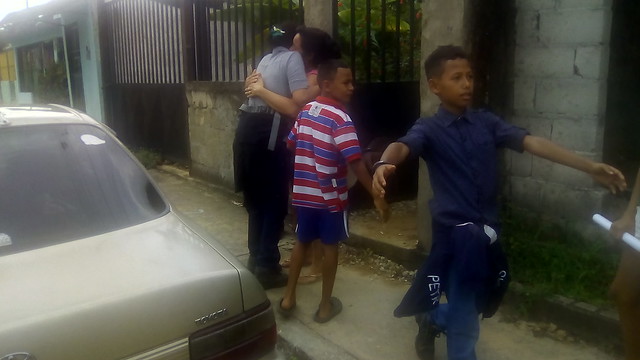
Luz Maria bids farewell to her grandson, Pedro.
But everyone can
agree that bringing more people into the church (God’s sheepfold)
is an important missionary objective, although not the only one. So,
the point was, you might be bringing lots of people into the church
through the “front door” (baptisms, confirmations, transfers of
membership), only to be experiencing net loss of members through the
“back door”: People slowly drifting away from the church.
Evangelism, therefore, meant not only presenting the Gospel to the
unchurched, but also discipling and involving new members in the life
of the church as quickly as possible.
Now, in a North
American setting, one of the factors that may contribute to backdoor
losses is people moving away to another city or state. But none of
those discussions of 30 years ago dealt with the situation that our
mission faces now. And not just our mission, but other congregations
in the Lutheran Church of Venezuela and other church-bodies as well.
This situation is the sudden, snowballing mass emigration of people
from the country. Imagine people who have been active and
enthusiastic members of your congregation suddenly deciding that they
can’t take it anymore and moving themselves and their families
abroad.
Here the border is
almost in our backyard, if not at the back door. La Caramuca is a
town of about 5,000 people just outside of Barinas, a city of several
hundred thousand. Only two or three years ago, we could catch a bus
into Barinas at a corner less than a block from the mission. Now we
have to walk across La Caramuca to the highway to catch a bus. The
highway is national Highway 5, which you can take from Barinas all
the way to Valencia. Then at Valencia you can hop on the four-lane
freeway to Caracas. It’s a journey of seven to eight hours by car
or bus.
But rather more
people these days are interested in traveling the opposite direction
on Highway 5. From Barinas, it’s about four or five hours to San
Cristobal, the last major city before you reach the Colombian border.
Highway
5 long has been a pipeline for the smuggling drugs, firearms and
other contraband to secret airstrips and ports on the Venezuelan
coast.
I visited San
Cristobal once when I fell asleep on the bus back from Caracas and
did not wake up when it stopped in Barinas. That was in 2007, and
even then, the U.S. State Department has a standing waring against
U.S. citizens traveling that close to the border, because of all the
fun and games with paramilitary groups/drug traffickers in the
borderlands.
Most of the people
leaving Venezuela are young enough to hope for careers and families
in their future, and able-bodied enough to work and try to send money
back to relatives who are not so fortunate. Those left behind are the
very old and the very young; parents in many cases have left their
small children in the care of grandparents. These, of course, are
people especially vulnerable to the shortages of food and medicine.
We are ṕleased to work with Global Lutheran Outreach to meet
these needs within the parameters that have been set for us.
Above all, we
continue to offer a message of hope in the midst of a national
crisis. Preaching, or public proclamation of the Gospel, must be by
“whether in season or out of season”, according to the English
Standard Version translation of 2 Timothy 4:2. Whether the current
situation is an opportune time or not may be a matter of perspective.
In the midst of great instability, people may be the most ready to
receive the good news of the Lord’s continued presence, now and
forever, in the lives of those who believe and have been baptized.
Nevertheless, whether opportune or not, the public proclamation of
the Gospel must continue. To combine Word and sacrament ministry with
works of mercy and compassion has a
long history among us.
We continue also to
pray for the Venezuelans in exile; that they may find the better life
they seek, but also may be fed with the Word and sacraments. Thanks
be to God for Lutheran mission work in Ecuador and Peru.
“Commit your work to the Lord, and your plans will be
established. The Lord has made everything for its purpose, even the
wicked for the day of trouble. Everyone who is arrogant in heart is
an abomination to the Lord; be assured, he will not go unpunished. By
steadfast love and faithfulness iniquity is atoned for, and by the
fear of the Lord one turns away from evil. When a man's ways
please the Lord, he makes even his enemies to be at peace with him.
Better is a little with righteousness than great revenues with
injustice.” Proverbs 16:3-8
“Diaspora” is derived from Διασπορᾷ, a Greek word that means “dispersion” or “scattering”. It literally means “to seed apart” (dia, apart, plus speiren, to seed). Nowadays, in English and other languages, diaspora means the flight of a religious or ethnic group from their homeland because of a catastrophic event, and the dispersion of their language and culture.
There have been many diasporas throughout human history. For instance, the mass emigration of the Irish during the great potato famine of 1845 to 1849. My own ancestors (those that spoke German) were among the “altluteraner”, the Old Lutherans, who fled religious persecution in the Kingdom of Prussia in the early 1800s. Some of them emigrated to the United States, others to Australia.
Many people today understand Diaspora with a capital “D” to mean the forced flight of the Jews from the Holy Land after the Romans destroyed Jerusalem and the Temple in 70 A.D. But that was not, in fact, the first Jewish diaspora. The Babylonians under King Nebuchadnezzar II also destroyed Jerusalem and the first Temple, built by Solomon, in 586 BC. Later the Persian Emperor Cyrus allowed the Jewish people to return to their homeland and rebuild the city and the temple. But many Jews did return, and, during the 300 to 400 years before Jesus was born, thriving Jewish communities grew in nearly every part of the ancient Mediterranean world. This also meant that many parts of the pagan world gained familiarity with the Jewish language, culture and religion.
By the early first century, “the diaspora” had come to mean the entire community of Jews living outside of the Holy Land. The word is used in this way in John 7:35. The dispersion of Jewish Christians from Jerusalem in the face of persecution (but before the destruction of the city) is described as “the diaspora” in James 1:1 and 1 Peter 1:1
It was the diaspora of both Jews and Jewish Christians that provided the seedbed in which the early church grew beyond the boundaries of Jerusalem and of Jewish culture. Paul, who was known as, and called himself, “the apostle to the Gentiles”, on his missionary journeys always first seek out a synagogue in the cities that he visited.
Likewise, in Venezuela, Lutheran Church – Missouri Synod work begin in the early 1950s primarily in response to a call from Germans who had migrated to Venezuela in the aftermath of World War II. This led in time to the development of a predominantly Spanish-speaking Lutheran Church of Venezuela.
Which brings me to the topic of the “Venezuelan diaspora”. While the flight of Syrians from their country’s civil war has been called the century’s first great refugee crisis, some analysts estimate the exodus of Venezuelans from Venezuela may surpass it.
"The next refugee crisis is not being driven by a violent war but by a socioeconomic disaster of magnitudes hardly seen before," says Dany Bahar, a Brookings Institution economist. While United Nations data indicates there are currently 5.5 million Syrian refugees, about 4 million Venezuelans (over 10 percent of the population) and the number of Venezuelan refugees could surpass that of Syria.
“This is a humanitarian crisis,” Willington Munoz Sierra, regional director of the Scalabrini International Migration Network, a Catholic charity running a shelter in Cucuta, Colombia, told the Washington Post. In Cucuta and other border towns, desperate Venezuelans are live in parks and cheap motels or sleep on sidewalks.
As sad as this situation is, it is encouraging to hear that the dispersion of Venezuelan Lutherans may open doors to mission and mercy work in surrounding countries. On May 6, we said farewell to Luz Maria’s daughter, Yepci, and her three children, Aaron, Oriana and Elias, as they left for Peru. Our prayers were answered as they arrived safely in Lima. LCMS missionaries and former members of La Fortaleza Lutheran Church in Maracay, Venezuela, came to their aid. They have both a place to live and a place to worship.
Lutheran Church—Missouri Synod involvement in Peru began in 1997, when the LCMS awarded a grant for flood relief and medical care. In August 2007, an 8.0 magnitude earthquake struck south of Lima killing more than 500 people, injuring more than 1,000 and destroying more 34,410 homes, according to news reports. LCMS missionaries traveled to Lima, Lucumo and Lunahuaná two weeks after the earthquake to evaluate how they could respond to the people in need. Missionaries handed out Bibles, food and personal hygiene products, and they got approval from the local government authorities to work there.
Lima is one of the largest cities in the Americas. Roughly 10 million people live there, which means that Lima contains one-third of Peru’s population. Mission sites in Lima include La Victoria, San Juan de Lurigancho, Chorillos. San Borja, and Los Olivos. Most of the Venezuelan expatriates attend the congregation in Los Olivos, says Cullen Duke, missionary pastor.
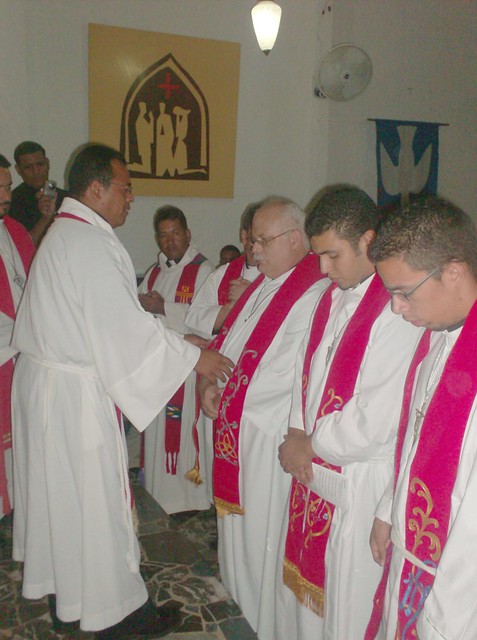
Pastor Adrian Ventura at my ordination in 2008.
LCMS missionaries in Peru also prepare for the arrival and service of short-term teams, which perform many tasks, such as assisting with construction work in villages and teaching English in order to build relationships and share the Gospel. I was pleased to learn of the imminent arrival of such a team from Messiah Lutheran Church, Hays, Kansas, where I was a member from 1977 to 1980.
Venezuelan Lutherans also have found a new place to live and worship in Chile. On May 5, 2018, Adrian Ventura was installed May 5, 2018, in Constitución, Chile,as a church planting pastor. For more than 20 years, Adrian was pastor of Cristo Rey (Christ the King) Lutheran Church in Maturin, Venezuela, his native city. He twice served as president of the Lutheran Church of Venezuela. Pastor Adrian was the first Venezuelan pastor that I had the privilege to meet in 2002. Pastor Adrian shares responsibility with Omar Kinas, a pastor of the Confessional Lutheran Church of Chile for mission work in Concepción, Chile. Pastor Adrian is serving Venezuelan expatriates and others in his new call.
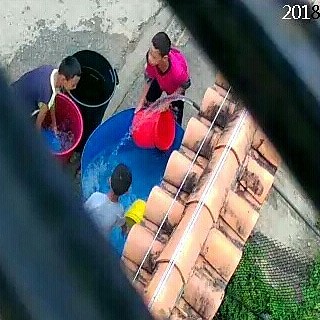
Sharing water.
Meanwhile, here in La Caramuca, we continue to attend the needs, spiritual and material, of those who remain in Venezuela. Since there is no public water system for the foreseeable future, we have been sharing the water from our well with our neighbors. We pray every Sunday as a congregation and every day in our homes for those Venezuelans who have left, and that God may grant us what we need to provide refuge, hope and assistance in this dark place.
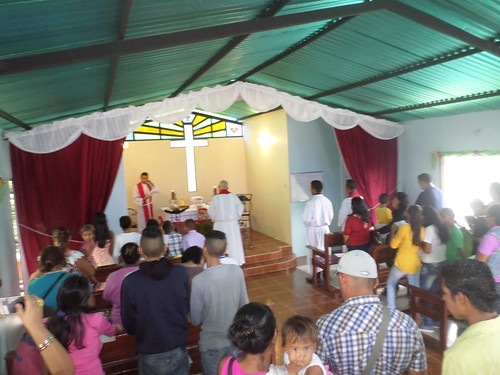
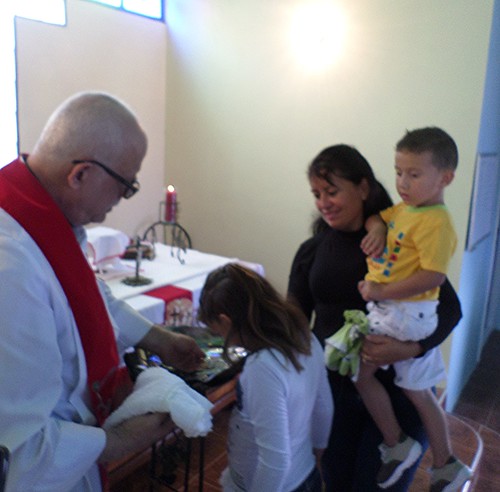
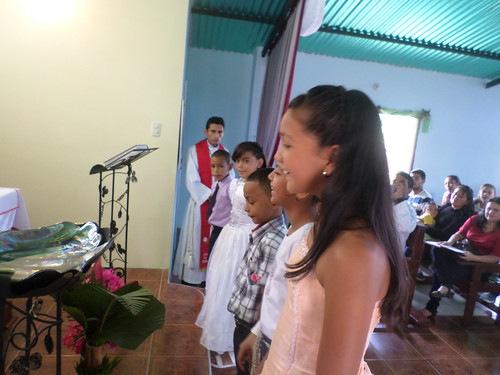
On January 8, 2017, we celebrated the Baptism of our Lord (Matthew 3:13-17) by baptizing three and receiving five as communicant members by rite of confirmation.
Those baptized were:
Anyelimar Katiusca Mesa Ruíz;
Naiker Daniel Ruíz;
Diana Carolina Torres.
Those publicly professing the faith and receiving first communion were:
Escarleth Mariuzy Ruíz;
Maryuri Daniela Rojas;
Eduar José Garrido;
José Ignacio Garrido;
Frenyerlin Novoa.
During the dedication our chapel which opened the Divine Service, I said: Now I dedicate and set apart the edifice of Epiphany Lutheran Church and all of its (communion) vessels to the glory and honor of almighty God and the edification of our faith, which is in Jesus Christ. In the name of the Father, the Son and the Holy Spirit. Amen.
It was the first time that I publicly named our congregation, “Epipany Lutheran Church.” Later I welcomed those receiving first communion in the name of Epiphany Lutheran Church and signed all the certificates of baptism and confirmation on behalf of Epiphany Lutheran Church.
Up until now we have identified this place, this project, as Epiphany Lutheran Mission. So what's in a name? Are we a “church” or a “mission”? Well, both, if properly understood.
The first baptism was performed here in 2005. there have 19 baptized and 27 received as communicant members by confirmation or reaffirmation of faith. Our Lord promised that “wherever two or three or gathered in My name, there am I in the midst of them” (Matthew 18:20). This is after He speaks of how to deal with an erring brother and says of the church, “Truly, I say to you, whatever you bind on earth shall be bound in heaven, and whatever you loose on earth shall be loosed in heaven. Again I say to you, if two of you agree on earth about anything they ask, it will be done for them by my Father in heaven.” This is understood as the bestowing the Office of the Keys on the church on earth, even the smallest of local churches.
C.F.W. Walther, in his landmark work, “Church and Ministry”, says “the church”, properly understood, is the aggregate of all those who, called out of the lost and condemned human race by the Holy Spirit through the Word, truly believe in Christ and by faith are sanctified and incorporated in Christ. In this true church, there are no liars or hypocrites. The total membership of this true church is known only to God, who knows the most intimate secrets of the heart, thus it is “invisible” to us.
However, Scripture also calls the visible aggregate of all the called, that is, of all who confess and adhere to the proclaimed Word and use the sacraments, which consists of good and evil persons, “church”. So also it calls local congregations, found here and there, where the Word of God is preached and the sacraments administered, “churches”. Wherever there are Word and sacraments, there will be found true Christians, even though there may be false Christians in the visible assembly. God ultimately will judge those put on a false show of faith (Matthew 13:24-30), but for the sake of the faithful in the visible assembly, He recognizes the right of the smallest congregation, even one consisting of two or three people, as possessing all of the authority which He has given to the whole church. That is, to proclaim God's Law, the message of judgment, to the unrepentant, but the Gospel, the message of salvation and forgiveness, to the repentant sinner.
Even the smallest congregation has the right and the responsibility to call and place men, who have been properly prepared and examined, into the office of the holy ministry, which is the office of publicly proclaiming the Word and administering the sacraments in the name of Christ and His church. Local congregations also have the right and, indeed, the responsibility to send and support called and ordained ministers to preach and administer the sacraments in places where a stable community of professed Christians has not been established.
“For everyone who calls on the name of the Lord will be saved. but how are they to call on Him in whom they have not believed? And how are they to believe in Him of whom they have never heard? And how are they to hear without someone preaching? And how are they to preach unless they are sent? As it is written, How beautiful are the feet of those who preach the good news!” Romans 10:13-15.
This generally is what is meant by “mission” or “mission work”. But it is the same ministry of the church: Preaching and administration of the sacraments. The Great Commission ties it all together: And Jesus came and said to them, All authority in heaven and on earth has been given to me. Go therefore and make disciples of all nations, baptizing them in the name of the Father and of the Son and of the Holy Spirit, teaching them to observe all that I have commanded you. And behold, I am with you always, to the end of the age.” (Matthew 28:18-20).
But we may distinguish, in common usage, between those who send and those who receive. We speak of a “mission” or “mission congregation” as a group of believers who do not have the resources to materially support a ministry in one location, much less send missionaries to distant shores. Other congregations (“churches”) may contribute toward the support of a resident pastor, construction of facilities or other needs.
Ideally a newly planted congregation would quickly grow to the point where it can not only support its own ministry, but mission projects outside its own locality. But any number of factors, both spiritual and material, may impede that progress.
Epiphany Lutheran Church of La Caramuca, Venezuela, has been a local church effectively since that first baptism in 2005. We remain a mission in both senses. We continue to try and reach those who do not know the hope of eternal life in Christ with the Gospel, and to show them God's love in action by helping them with their material needs. Also, we continue to depend on donations from concerned individuals, mission societies and other congregation in order to continue being a blessing to our community.
Most of the families that we serve have for generations been plagued by instability in work and personal relations. It was one of our objectives from the beginning to help them break the cycle of poverty imposed by false beliefs through Christian education. Now the entire country is gripped by an economic crisis in a world that seem to be gripped by fear and uncertainty. We ask, that if you have the means, please consider helping keep shining a light in the present darkness. You may donate on-line at this Web site. Thank and God bless.
Nearly 15 years ago I joined a group of people who were forming a society to organize and raise funds for short-term mission trips to Venezuela. Most of them were members of St. Michael's Lutheran Church of Bloomington, Minnesota, and Woodbury Lutheran Church of Woodbury, Minnesota, and most already had made one trip to the Latin American country.
Many evening hours were spent drafting a constitution and by-laws, and attending to the mechanics of setting up what would be recognized as a non-profit organization by the state of Minnesota and the federal government of the United States. We also applied for and received membership in the Association of Lutheran Mission Agencies (ALMA). The resulting mission society was named the Venezuela Lutheran Mission Partnership (VLMP) and throughout the first decade of the 21st Century, VLMP would organize a series of successful mission trips and raise a considerable amount of money in support of the Lutheran Church of Venezuela.
Pastor Phil Bickel
Pastor Paul Pfotenhauer
Many people were involved in the formation of VLMP. As pastoral advisers we had Philip Bickel, then missions pastor at St. Michael's, and Paul Pfotenhauer, founding pastor of Woodbury Lutheran Church. Dale and Elizabeth Thompson, members of Woodbury, often hosted our organizational meetings at their home. Denny and Karen Rosen invited a group from VLMP to speak at St. Paul's Lutheran Church of Perham, Minnesota, and let us relax at their wonderful lakeside residence.
But it was Frank Janssen, a retired 3M engineer and member of Woodbury, who recently notified that VLMP had disbanded. Frank and I signed VLMP's charter with the state of Minnesota. Early in 2003 I rode with Frank and his wife, Kathy, from the Twin Cities to the ALMA annual convention in St. Louis and received a delightful guided tour of Iowa from native son, Frank. Eventually Frank would visit our mission in La Caramuca and his alter ego, Paco the Clown, would entertain the children.
Paco the Clown
Frank explained to me that, due to increasing concern over the political and economic instability in Venezuela, and the resulting unrest and violence, VLMP had not sent any short-term mission teams to Venezuela for the past several years. Without the "hands-on" experience that had driven the organization in its early days, many people formerly involved with it, had moved on to other interests.
So ends a chapter in the history of Lutheran mission work in Venezuela, but I do not believe that it is the end of the story. There remain many people in spiritual and material need here, and many opportunities to do the Lord's work. However, due to the current crisis, it will remain difficult for the national Lutheran church to sustain mission projects without help.
Since 2004, Epíphany Lutheran Mission of La Caramuca has depended on donations from individuals, congregations and mission societies in the United States. In the past we have directed anyone wishing to support our mission financially to send their contribution to VLMP, which has acted a clearinghouse for funds earmarked for Venezuelan projects. Now that VLMP is no longer in operation, I have set up a crowdfunding site where interested parties may donate to us on-line. We hope to gain more long-term donors for, God willing, we plan to expand our service to the people around us.
For the sake of the Gospel, St. Paul
was beaten, imprisoned, and often near death. “Five times I
received at the hands of the Jews the forty lashes less one. Three
times I was beaten with rods. Once I was stoned. Three times I was
shipwrecked; a night and a day I was adrift at sea; on frequent
journeys, in danger from rivers, danger from robbers, danger from my
own people, danger from Gentiles, danger in the city, danger in the
wilderness, danger at sea, danger from false brothers; in toil and
hardship, through many a sleepless night, in hunger and thirst, often
without food, in cold and exposure.” (2 Corinthians 11:25-27).
In that light, a shortage of toilet
paper may not seem like that big a deal. In fact, we regularly buy
supplies in bulk, so we have not been hard hit by this problem as
yet. Nor am I trying to be flippant about it; rather, I am reminding
myself that the Lord was with the Apostle Paul through much worse.
For Venezuelans in general, however,
the situation is more serious than it might sound. For a number of
years, Venezuelans have had to deal not only with 30 percent
inflation, but also flat-out shortages of basic foodstuffs like
flour, margarine, cooking oil, sugar, eggs and milk. We have seen for
ourselves the empty supermarket shelves, but at least we can afford
to shop in supermarkets. The very poor perhaps can obtain these items
through government welfare programs, but that means being willing and
able to get up and present yourself at the designated distribution
center at 3 or 4 a.m. That's no joke if you are a single parent with
small children.
Recently the shortages have broadened
to include personal
hygiene supplies such as toiler paper, soap and toothpaste. At
the same time, sanitary measures have become more important than ever
with a renewed outbreak of H1N1
influenza in Venezuela. Seventeen people have died and
approximately 250 more have been infected, Reuters reported this
week.
Also known as “swine flu”, the 2009
pandemic, which began in the state of Veracruz, Mexico, and soon
spread throughout Mexico, North America, and parts of South America,
was one of the worst flu outbreaks in history. It ultimately killed
18,500 people, according to the World Health Organization (WHO). The
last outbreak in Venezuela was in 2011, with about 100 cases
reported. Preventative measures to stop the spread of the disease
include frequent washing of hands with warm, thoroughly cleaning
surfaces that many people might touch, and using tissue paper to
cover the mouth and nose while sneezing.
Ir certainly is heartwarming to hear
how Christians in the United States and around the world respond to
natural disasters like tornadoes, hurricanes, earthquakes, or
large-scale crop failures with donations to help those affected. One
might wish, however, that more people would understand that in many
parts of the world, poverty, homelessness, malnutrition and disease
are chronic, long-term problems that have become so commonplace that
they do not generate international headlines. Often people are in
need not because of some inexplicable “act of God”, but rather
because of the predictable consequences of human folly, perhaps their
own. That, however, does not negate the biblical mandate to share the
material blessings with which we have been blessed with those less
fortunate (Proverbs 25:21; Isaiah 58:6-7, 10; Matthew 25:35-36).
Here in La Caramuca, people not only
bear the brunt of national and international events, but also are
trapped in a cycle of poverty and despair because of family
instability, marital infidelity, domestic violence, drug and alcohol
abuse and false beliefs that do not satisfy their spiritual hunger.
The first priority of our mission is to bring them the good news of
Jesus Christ, that in Him one might have a right relationship with
God who loves us all and does not desire that anyone be locked in
misery and despair.
We also try to demonstrate that one may
trust God to provide all things by sharing what we have been given.
On our property we have many fruit trees that Luz Maria planted
herself back in the 1990s. These produce more than we can consume
ourselves: oranges, bananas, avocados, mangos and grapefruit. We also
have planted squash and cassava, a tuber similar to the potato which
thrives in tropical regions. The abundance of these plants we share
with the surrounding community.
Our preschool is supposed to provide
two nutritionally balanced meals per day for the children with funds
provided by a state program. However, the number of children has
grown faster than the program's annual budget, so most months the
funds run short. Luz Maria and I have made up the difference. We have
worked with others in collecting and distributing clothing and other
supplies for needy families.
We have been able to do these things by
God's grace and with donations from individual and congregations in
the United States. We are grateful to those who have enabled us to do
the Lord's work and we pray that more might understand the necessity
as Venezuela face political and economic difficulties.
Although we have a small group of people that have been baptized and confirmed as Lutherans, our mission actually serves a somewhat wider community. Because there are so few schools with any kind of Christian orientation here, some of the people who send their children to our preschool are devout Roman Catholics or Pentecostalists. The father of one of our little girls is the pastor of a Pentecostalist church, while two of our preschool teachers are Catholic (ideally, all of our teachers would be Lutheran, but Venezuelan law dictates that the preschool have a certain number of state-certified teachers and there are not that many state-certified Lutheran teachers here).
Of course we do not demand that faithful members of other churches join ours in order to send their children to our preschool. Attendance at our Sunday services is alway be invitation. Therefore, we strive to maintain a solidly Lutheran position in doctrine and practice while respecting the beliefs of those who subscribe to other confessions.
The preschool will be closed for Holy Week, therefore we are using this week to teach the preschool children that Holy Week means something other than vacation time. One of our teachers, Yosaira, had approached me with her huge family Bible. It was a "Catholic" Bible, including the "deuterocanonical" books in its Old Testament and some beautiful color-plate illustrations of the traditional Stations of the Cross. Yosaira thought perhaps we could scan the illustrations and use them to teach the children about the events of Good Friday.
The Stations of the Cross were first mentioned in writings from the fifth and sixth centuries as a series of numbered stops for pilgrims to meditate and pray while retracing the Via Dolorosa, or Christ's path from the Garden of Gethsemane to Golgotha, in Jerusalem. Supposedly these were places where Jesus paused on His way to the Cross, except for the last four which involve Him actually being nailed to the cross, dying, and being taken down and laid in the tomb. Eventually a list of 14 "stations" became the accepted norm and every year to this day hundreds of Christian pilgrims to Jerusalem follow this pattern in following the Via Dolorosa.
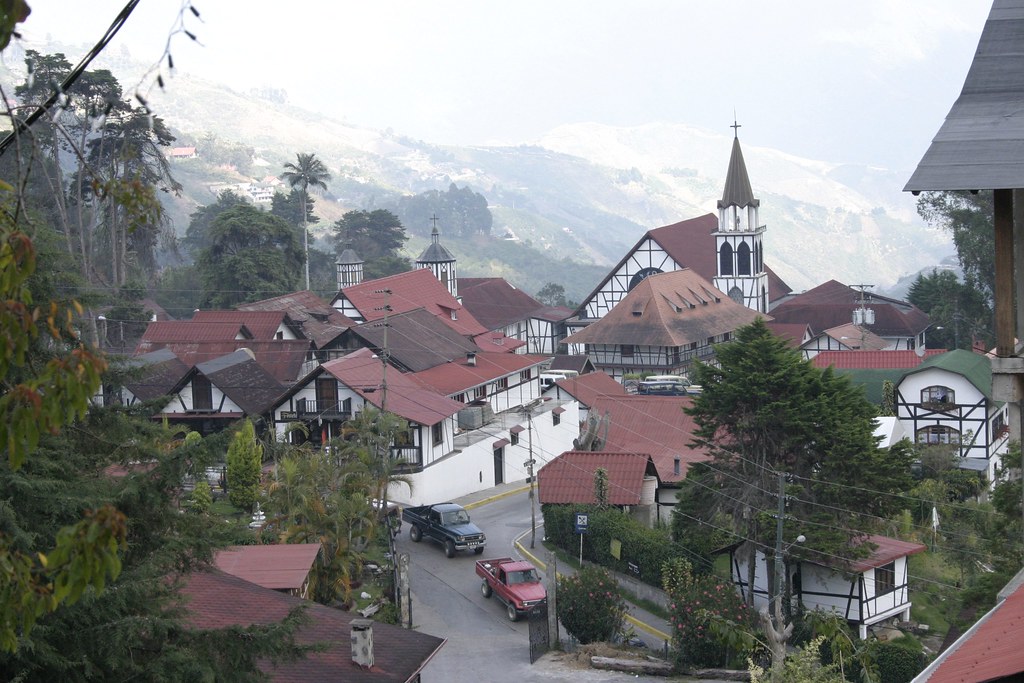
Somewhat later, since relatively few people had the time or money to travel to Jerusalem, it became a devotional practice to recreate the path to the Cross with paintings or crosses along a circumscribed route in a church or elsewhere. For example, in Colonia Tovar, a German-Catholic enclave in the mountains north of Caracas, the main street of the town is marked with crosses representing the Stations of the Cross as it winds down to its end at St. Martin of Tours Church.
The imagery of the Stations of the Cross have provided inspiration for Christian art for centuries. Not only paintings and sculpture, but also Christian theater, as the European "Passion Play" tradition incorporates dramatizations of the various stations. This includes Mel Gibson's movie, "The Passion of the Christ," which is essentially a Passion Play on film (see postscript on Passion Plays).
However, there is a problem with the traditional Stations of the Cross: Not all of them are really part of any of the New Testament narratives. The traditional 14 Stations of the Cross are as follows:
Jesus is condemned to death
Jesus is given his cross
Jesus falls the first time
Jesus meets His mother
Simon of Cyrene carries the cross
St. Veronica wipes the face of Jesus
Jesus falls the second time
Jesus meets the daughters of Jerusalem
Jesus falls the third time
Jesus is stripped of His garments
Jesus is nailed to the cross
Jesus dies on the cross
Jesus' body is removed from the cross
Jesus is laid in the tomb and covered in incense
Only eight of these stations have clear Scriptural foundation. Numbers 3, 4, 6, 7 and 9 do not and the traditional representation of Jesus' body being placed in His mother's arms as it is lowered from the cross in number 13 is an embellishment of the New Testament story. The Roman Catholic Church today recognizes this and, as I pointed out to Yosaira, in 1991 Pope John Paul II approved an alternative form of the Stations of the Cross that is completely consistent with the Scriptures. This form also was approved by Benedict XVI in 2007. This is the new pattern:
Jesus in the Garden of Gethsemane
Jesus is betrayed by Judas and arrested
Jesus is condemned by the Sanhedrin
Jesus is denied by Peter
Jesus is judged by Pilate
Jesus is scourged and crowned with thorns
Jesus takes up His cross
Jesus is helped by Simon to carry His cross
Jesus meets the women of Jerusalem
Jesus is crucified
Jesus promises His kingdom to the repentant thief
Jesus entrusts Mary and John to each other
Jesus dies on the cross
Jesus is laid in the tomb
Jesus rises from the dead on the third day
I told Yosaira I would have no problem with using this form of the Stations of the Cross. We used most of the pictures from her Bible and I filled in the gaps with graphics from the Wisconsin Synod Web site.
There is another problem with the Roman Catholic interpretation of the Stations of the Cross and that is this form of devotion still is considered an "act of reparation" or, in essence, a meritorious work.
"Reparation is a theological concept closely connected with those of atonement and satisfaction, and thus belonging to some of the deepest mysteries of the Christian Faith. It is the teaching of that Faith that man is a creature who has fallen from an original state of justice in which he was created, and that through the Incarnation, Passion, and Death of the Son of God, he has been redeemed and restored again in a certain degree to the original condition. Although God might have condoned men's offences gratuitously if He had chosen to do so, yet in His Providence He did not do this; He judged it better to demand satisfaction for the injuries which man had done Him. It is better for man's education that wrong doing on his part should entail the necessity of making satisfaction. This satisfaction was made adequately to God by the Sufferings, Passion, and Death of Jesus Christ, made Man for us. By voluntary submission to His Passion and Death on the Cross, Jesus Christ atoned for our disobedience and sin. He thus made reparation to the offended majesty of God for the outrages which the Creator so constantly suffers at the hands of His creatures. We are restored to grace through the merits of Christ's Death, and that grace enables us to add our prayers, labours, and trials to those of Our Lord "and fill up those things that are wanting of the sufferings of Christ" (Colossians 1:24). We can thus make some sort of reparation to the justice of God for our own offences against Him, and by virtue of the Communion of the Saints, the oneness and solidarity of the mystical Body of Christ, we can also make satisfaction and reparation for the sins of others."
Certainly Colossians 1:24 read in context does not support the above assertions. Paul writes in Colossians of the redemptive work of Christ as being sufficient to atone for all the sins of all men. In verse 24, he says that he is able to endure "the sufferings of Christ", that is, the difficulties that he, as a preacher of the Word, experiences above and beyond the normal problems of life for the sake of Christ, as being something that will benefit Christ's body, the Church. If he, Paul, is able to endure these sufferings, then perhaps the Church will be spared some suffering for the sake of Christ. But as in baptism Christians share in the resurrection of Christ, they also will share some of the same sufferings as Christ (persecution and rejection by the world). In no sense, however, do our sufferings add anything, or need to add anything, to the price Christ paid for our sins on the cross.
I addressed this issue in an introductory talk to parents and children on Monday and again in my presentation of the pictures on Wednesday, saying that our worship and praise during Holy Week were not required of us to earn His love and favor, but rather were our response to what Jesus did for us on the cross. Through His suffering and death on the cross He paid the full price for our sins and that therefore we are justified before God through faith in Him, not through any of our works. Therefore, the Stations of the Cross ares simply a tool for us to remember and appreciate Christ's sacrifice for us.
No preschool next week, but our Holy Week schedule includes services on Palm Sunday, Good Friday and Easter Sunday. Postscript on Passion Plays
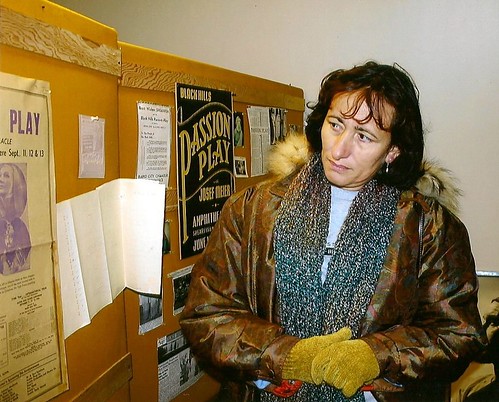
When Luz Maria and I visited my family in South Dakota in 2006, we stopped at the Spearfish Amphitheater in Spearfish, S.D., which for nearly 70 years was the main venue for the Black Hills Passion Play. The Black Hills Passion Play was presented on a 350-foot outdoor stage with seating for 6,000 people. Performances were Tuesdays, Thursdays and Sundays during the summer months.
In 1932 a troupe of Passion Players from Lünen, Germany, where a Passion Play had been presented since 1242, began touring the United States. One of them was Josef Meier, a seventh-generation Passion Player. Their script was in German, which meant their engagements were limited to theaters and churches frequented by German-speaking immigrants. Because of political and economic conditions in Germany, Meier decided to stay in the United States. He had the script translated into English, hired American actors to replace the German cast, and while touring various towns, began looking for a permanent home for his Passion Play. Spearfish was chosen in part because of the site's excellent natural acoustics. The amphitheater was built in 1939. During its heyday, the Black Hills Passion Play company not only made special appearances throughout the United States and Canada, but in 1953 established a winter home in Lake Wales, Florida, where the play was presented until 1998.
There were no performances scheduled for the winter of 2006, but Luz Maria and I were given a personal tour of the Black Hills Passion Play Museum by Guido Della Vecchia, husband of Johanna Meier, Josef's daughter. Guido spoke Italian while Luz Maria spoke Spanish, and they were able to communicate to a limited extent.
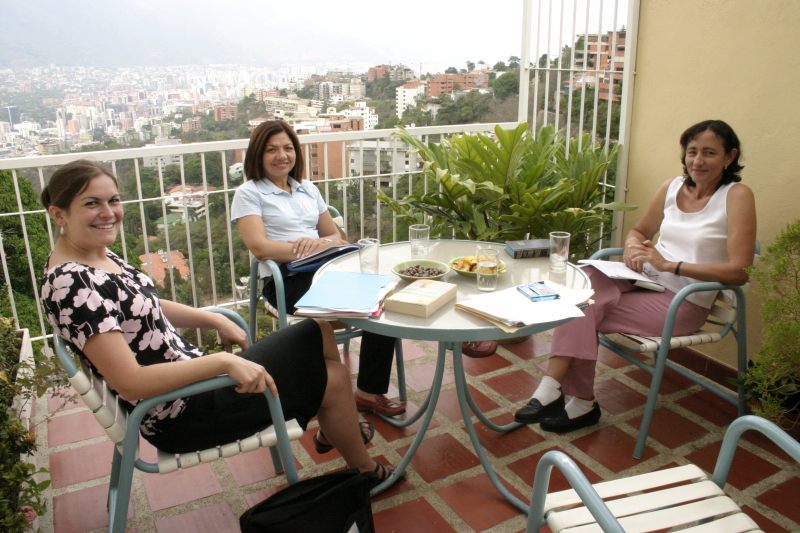
Elsy Valladares de Machado of Caracas will be Luz Maria's traveling companion. Together Luz Maria and Elsy are national coordinators of the Lutheran Church of Venezuela's deaconess program.
Clearly I did not marry just any Venezuelan. It is said the new model for overseas missions is for North Americans to work in partnership with national church leaders, a concept that we have taken to an extreme.
Nevertheless, there is a lot to be said for it. Over the last 50 years, the world has seen phenomenal growth in the number of Christians living in "the Global South" (Africa, Asia and Latin America) or "Majority World" and the emergence of national churches there.
The term "Majority World" has come to be used as a replacement for "Third World" or "developing world", and it has a double meaning. First, the majority of the world's human population now lives in Africa, Asia or Latin America. Second, so does the majority (75 percent) of the world's Christians.
According to Pennsylvania State University professor Philip Jenkins, author of an influential Atlantic magazine article, "The Next Christendom" (which he later developed into a bestselling book):
“Christians are facing a shrinking population in the liberal West and a growing majority of the traditional Rest (of the world). During the past half-century the critical centers of the Christian world have moved decisively to Africa, to Latin America, and to Asia. The balance will never shift back.” Yet Christians in the United States still have the financial resources, educational institutions and, above all, the religious liberty, to train and send cross-cultural missionaries that many national churches do not. There are not that many places in the world where there is a happy combination of all three of these things.
Becoming a cross-cultural missionary means not only receiving a sound theological education, but also learning to live day-to-day in an environment where the language and customs are very different. But even with the amount of preparation involved, once a trained cross-cultural career missionary is in place, it often is more economical to support such a person than to rely on short-term volunteer missionaries.
According to Dr. Rutt, "What we have seen in our circles is that there is precious little preparation of a missiological nature for those missionaries coming from the majority world. While typically they have a thorough theological education at a residential seminary, most have had almost no orientation in cross-cultural ministry, linguistics, mission strategy, mission history, and theology of missions...Too often we have made assumptions about the readiness of a family to live and work in another part of the world that have proved to be false because we assume the cultures are similar. For example, if you send a Brazilian family to work in a place like Panama, you may assume that, since they are Brazilian from Latin America, they will have to cross very little cultural and linguistic distance to minister effectively in Panama, another Latin American country. Our experience has been that in this kind of situation those Brazilians who go to a place like Panama run into the same kinds of misunderstandings in their new home, make the same kinds of inaccurate judgments about the new culture, go through the same culture shock, experience the same loneliness and isolation, often have similar linguistic challenges, and go through the same kinds of trials and tribulations that are a part of becoming enculturated in a new society, just like any of our missionaries from the U.S."
Nevertheless, from 1988 to 2008, the number of "career missionaries" sent out by U.S. mission agencies declined by 45 percent. Ralph D. Winter, founder of the U.S. Center for World Missions, said in a 2007 speech to the Asian Society of Missiology in Bangkok. that nearly two million short-term volunteers leave the United States each year compared to 35,000 long-term missionaries. It costs at least five time more overall to send a short-term volunteer than a long-term missionary – financial support that Winter suggested would be better invested in a long-term missionary. (In 2005, Time magazine included Winter in a special feature section on "America's 25 Most Influential Evangelicals")
Not that there is anything intrinsically wrong with short-term mission trips. These trips may yield long-term results if:
Volunteers are moved to consider preparing for a career in the mission field themselves;
Or, return home with a renewed zeal to support long-term missionaries.
However, it is a question of balance. Craig Greenfield wrote in the February 2009 issue of Lausanne World Pulse: "...the mission pendulum has swung heavily toward resourcing local people...supplemented by short-term missionaries who focus on transferring their skills without learning the language and culture. But we must strive to find balance by remembering the rich biblical tradition of prophetic outsiders...Throughout biblical and recent history, God has used outsiders to bring about his purposes in foreign nations".
Greenfield is the international coordinator of Servants to Asia's Urban Poor. For six years he and his wife, Nay, lived among the urban poor in the slums of Cambodia.
In regard to "empowering" national church leaders, Greenfield writes "The concept of empowering people is central to good mission work. But it takes wisdom to discern the difference between empowerment and disengagement. Just as a good manager of people will know just how much to delegate and how much support to provide, so a foreign missionary needs to learn how to empower rather than overpower. However, not showing up at all is not empowerment; it is apathy".
In addition, according to Greenfield, "It is a beautiful and exciting thing to see African, Asian, and Latino missionaries spreading out across the globe, and there is much more that can be done to assist and support them. But when Jesus told us to go into all the world and make disciples, he wasn't letting any nation off the hook as though their contribution was not worthy or useful. We must come alongside our brothers and sisters from around the world and joyfully do our part in the Great Commission".
Luz Maria and I have this objective in our mission project: To use the strengths of our different backgounds to provide the Christian instruction sorely needed in this country, both at basic and advanced levels, and particularly for the region where we live. We thank God for the opportunity to serve and that we may continue the good work that has begun here in La Caramuca.
Spanish Portals of Prayer once more in print
Spanish translations of Portals of Prayer were at one time popular as devotional literature in Venezuela. Actually, they still are. But only used copies have been available since 2003, when Concordia Publishing House stopped printing Portales de Oracion. Since 2007, someone at El Salvador Lutheran Church has been faithfully transcribing the used copies in which the dates correspond to the current year and e-mailing to everyone on the Lutheran Church of Venezuela mailing list. The drawbacks to this include the time required for transcription and the costs of printing and making multiple copies of the e-mails every month.
Now there is another alternative as CPH has resumed publishing Portales de Oracion. Even better news is that this time the daily devotions will be composed in Spanish rather than translated from English as was the practice in the past. Individual subscriptions will cost $10. Presumably there would be the cost and logistics of shipping Portales de Oracion to Venezuela, but it has been done before.


 Latest shipment of medicine

 “For our citizenship is in heaven, from which we also eagerly wait for the Savior, the Lord Jesus Christ” (Philippians 3:20).







![Reblog this post [with Zemanta]](https://lh3.googleusercontent.com/blogger_img_proxy/AEn0k_tjG4uWflJ0dR6RphxrnmsK1KFfsMfcmS6awQv6Ifz94hb-khwqNcpT9qx5xiPReWYDBnWfWj1n1dfJWOKk3mOSDuA59sEQkMEByXAB2IKrPnYxcvWBe7N9b8CUjUD1EFLgCHkhWmsyRsGyO_siRu4G=s0-d)


![Reblog this post [with Zemanta]](https://lh3.googleusercontent.com/blogger_img_proxy/AEn0k_vw-qxCJQQqSHI3dA7aieADqL4Z3ZfwT8s1xOHIpc1eS75__jiuZFYjeAc1W9sC4roIkpSDZfnpOVxGEfe6dc2LjsSUtJx6vFz0cTneBNr56IWaGfMZLQkINGM3T_HIyHE0IdsPs3Me9sUP5po9ncc1=s0-d)