Showing posts with label venezuela earthquake. Show all posts

Aug 1, 2026

Recognizing the rights of children


Children's Day with VBS students.


Every third Sunday in July is Children’s Day in Venezuela a date chosen to coincide with the close of the school year. In 1936, the Venezuelan Federation of Teachers first promoted the idea of a date that recognized the rights of children. That year, a table of children's rights was drawn up, much of which is incorporated into the current national constitution and Organic Law for the Protection of Children and Adolescents. These rights. by the way, include the right to life conception. Abortion in Venezuela is currently illegal except in cases where the mother’s life is in danger. Penalties range from six months to two years in prison for women who seek abortions and two to three years for medical personnel who perform them. Also the right to live as a family, with priority on the biological family. Right to identity: Includes the right to a name, nationality and knowledge of family origin.

This year, Children’s Day fell on July 19, the seventh Sunday after Trinity. We held vacation Bible school on the preceding Thursday and Friday with the theme “Rescatados por Cristo para su gloria” (“Rescued by Christ for His glory”). A dozen children attended the first day and 17 the second day, mostly Luz Maria’s afterschool tutoring students, plus friends and family that they had invited.

Bible stories were the crossing of the Red Sea (Exodus 14) and the Apostle Peter being saved from drowning by Jesus as our Lord walked on the water of the Sea of Galilee (Matthew 14:22-33). The miracle of Jesus walking on water is also recorded in Mark 6:45-52 and John 6:15-21, but only Matthew includes the detail of Peter walking on the water toward Jesus until overcome by doubt. The crossing of the Red Sea is referenced in Hebrews 11:29 as an example of faith, but the example of Peter shows we are not saved by the strength of our faith, but by the power of the object of our faith, Jesus. In 1 Corinthians 10:1-4, St. Paul makes a direct comparison between the crossing of the Red Sea and baptism, and, while St. Peter does not describe his own experience, he speaks of being saved by the Lord’s action in baptism as Noah and his family were saved from the waters of the Great Flood (1 Peter 3:20-21).
 

The Feeding of 4,000
and fried rice


Sixteen children also attended the July 19 service, where we distributed school supplies to all and prizes to those who did the best at memory work. The service was followed by a meal of fried rice with chicken (often called “arroz chino” or “Chinese rice” and a birthday cake for Elzo Meza, one of the students.

The  theme fit in well with the Gospel reading appointed for the seventh Sunday after Trinity, Mark 8:1-9, St. Mark’s account of the miraculous feeding of 4,000 people. In Matthew 15:32-39 as well, Jesus walking on the water is sandwiched between the feeding of the 5,000, mentioned in all four Gospels, and the feeding of the 4,000. In both cases, the multiplication of loaves and fishes prefigures the institution of the Lord’s Supper (the Lord gives thanks, eucaristia, breaks bread and gives it to His disciples to distribute), while the multitudes following Jesus into the desert reveal that He is the Prophet greater than Moses (Deuteronomy 18:18). The difference being that the feeding of the 5,000 was for a predominantly Jewish crowd, while the feeding of the 4,000 took place in non-Jewish territory, indicating the Gospel was first for the Jews, then all nations.

The following week (July 20-24), we made our kitchen available for Luz Maria's sisters, Deniece Vergara and Rosaura Castillo, to prepare more chicken and fried rice for 55 students graduating from the main preschool in La Caramuca. Deniece is a certified gourmet chef and runs a restaurant, "La Mazorka", with her husband and daughter.


Anyi GarridoThe banner we used to advertise our vacation Bible school online was designed by Anyi Garrido, Luz Maria’s granddaughter. Starting in September, Anyi will begin her last year of “liceo” (equivalent to high school). She completed an extracurricular course in graphic design, as well as earning the second-highest grades in her class.


Señora safe and sound

We give thanks for the safe return of Rita Zapata from receiving cancer treatment in Barquisimeto, which is about three hours north of us. Rita was staying at “Cristo es Amor” (Christ is Love) Lutheran Church when the double earthquake struck on June 24. Barquisimeto was much closer to the epicenter so she experienced the walls and her bed shaking, but was unharmed.


Earthquake recovery continues
 

Venezuela as a whole continues to recover from the devastating earthquakes. Therefore, Global Lutheran Outreach has expanded its Venezuela relief program to include help for earthquake victims, as well as continuing the shipment of non-prescription medicines from Chile. To find out more, please visit the GLO earthquake relief page.


Luz Maria's daughter named deaconess

On August 1, 2026, Luz Maria's daughter, Yepci Santana, was consecrated as a deaconess at "Castillo Fuerte: Casa de Misericordia" ("Mighty Fortress: House of Mercy") in La Victoria (Lima), Peru. Yepci is director in charge of the afterschool program, assisting 40 children  , sports, musicin, crafts, cooking and workshops on Christian values, national identity, coexistence and personal improvement.

On July 11, Luz Maria and I had our first meeting, via Zoom videoconference, with the Reverend André Luiz Müller, GLO regional director for Latin America. Born in Brazil and raised in Paraguay, André has more than two decades of church and missionary service. He credits the support of his faith and his family—his wife Maíra Ferrari Reis and their three children, Helena, Martín, and Francisco—with helping him carry out his responsibilities. For more information, see his GLO page.

Aug 30, 2021

When the sea roars and the earth shakes

Brooklyn Museum - Jesus Stilling the Tempest (Jésus calmant la tempête) - James Tissot - overall 

Be still, my soul! the waves and winds still know

His voice who ruled them while He dwelt below.

Lutheran Service Book 752

The “dog days” of summer are winding down and, it’s hurricane season in the Caribbean! The season when hurricanes form runs from June to November, but the storms are more likely between August and October.

Hurricane Ida made landfall as a Category 4 storm, in New Orleans, August 29, 2021. Ida blasted ashore as one of the most powerful storms ever to hit the United States, knocking out power to all of New Orleans, blowing roofs off buildings and reversing the flow of the Mississippi River as it rushed from the Louisiana coast into one of the nation’s most important industrial corridors. It hit on the same date Hurricane Katrina ravaged Louisiana and Mississippi 16 years earlier, coming ashore about 45 miles (72 kilometres) west of where Category 3 Katrina first struck land. Ida’s 150-mph (230 kph) winds tied it for the fifth-strongest hurricane to ever hit the mainland United States.

Bret 1993-08-06 1431Z

A little more than a week earlier, Hurricane Grace pounded Mexico’s Yucatan Peninsula, downing trees and causing power outages for nearly 700,000 people. Then Grace moved on to the Gulf Coast state of Veracruz, causing severe flooding and mudslides that killed at least eight people. Before striking Mexico, the storm showered torrential rains on Haiti, a country still recovering from a 7.2-magnitude earthquake in Haiti on August 15.

Northern Venezuela and Colombia only have a 1 to 5 percent chance of a hurricane strike in any given year. The northernmost part of Venezuela, namely the Paraguanà Peninsula, the Paria Peninsula and the islands (but sometimes also the northern coast), is located in the southern end of the trajectory of hurricanes. But it can happen. From August 7 to 9, 1993, Tropical Storm Bret moved across northern Venezuela and Colombia. Mudslides resulting from the heavy rainfall claimed 173 lives, while 10,000 were left homeless, and property damages totaled $25 million ($37 million 2008 USD).

But although Venezuela seldom has to deal with full-fledged tropical storms, we are affected by “tropical waves”. A tropical wave is an area of low pressure in the atmosphere moving westward from Africa into the Atlantic. Tropical waves last from a couple of days to several weeks, with new waves forming every few days. On satellite, these disturbances appear as clusters of thunderstorms and convection originating over North Africa and traveling westward into the tropical Atlantic. By providing the initial energy and spin needed for a hurricane to develop, tropical waves act like "seedlings" of tropical cyclones. Approximately 60 percent of tropical storms and minor hurricanes (categories 1 or 2), and nearly 85 percent of major hurricanes (category 3, 4, or 5) originate from tropical waves.

Even if they do not cause hurricanes, tropical waves often bring with thunderstorms and flooding rains. That’s what we have received over the past few weeks. Tropical waves 38 and 39 have destroyed over 8,000 homes and forced about 35,600 citizens to refuge in shelters. Besides affecting 116 roads and ten bridges, floods and landslides have damaged power stations in the states of Amazonas, Barinas, Bolivar, Delta Amacuro, Merida, Monagas, Tachira, and Zulia. Multiple floods and mudslides in in the neighboring state of Mérida have left 20 people dead and more than 1,200 buildings destroyed.

Avocado harvest.

In La Caramuca,
we have only had to deal with power outages. Our solar panels continue to work well, keeping the lights and security cameras going and the cell phones recharged. All the rain means excellent crops of fruits and vegetables. Luz Maria and I share the produce with our neighbors, those who stop by the mission and those we visit on evangelistic calls.

There also was a 5.2-magnitude earthquake in Portuguesa, another neighboring state, on August 25, and a 4.9 quake off the coast of Sucre state on August 30.

All of which brings to mind Luke 21:8-11. “There will be great earthquakes, and in various places famines and pestilences. And there will be terrors and great signs from heaven.” As with many Biblical prophecies, the Lord in these verses speaks of two impending catastrophes, the destruction of Jerusalem and the end of the world, with one foreshadowing the other. So he warns his followers of the persecution that will precede the city’s downfall, and of false prophets who will predict the end of the whole world based on natural disasters and terrible wars. 

And there will be signs in sun and moon and stars, and on the earth distress of nations in perplexity because of the roaring of the sea and the waves, people fainting with fear and with foreboding of what is coming on the world. For the powers of the heavens will be shaken. And then they will see the Son of Man coming in a cloud with power and great glory. Now when these things begin to take place, straighten up and raise your heads, because your redemption is drawing near” (Luke 21:25-28).

For those of us living in these days, the Lord’s words also apply to hurricanes, earthquakes, COVID-19 and even the persecution of believers in Afghanistan and other parts of the world. Like the first-century Christians, we are not terrified by cataclysm, for we not the end will not come until the day God has pointed. Nor do we regard them as random events, but signs that great day will come. “All these are but the beginning of the birth pains,” says the parallel passage in Matthew 27:8.

All-powerful and eternal God, mercifully defend us from fires, floods, war and pestilence; from drought and storms, want and famine. Amen.

Jan 16, 2010

Epiphany and earthquakes

Adoration of the Wise Men by MurilloImage via Wikipedia

Happy New Year and a blessed Epiphany season to everyone! We celebrated the visit of the Magi to the baby Jesus in Bethlehem with a brief service of prayer on Wednesday, January 6. The group was comprised mainly of Luz Maria's family. We sang a beautiful Spanish Epiphany hymn:

Tras hermoso lucero, tres magos viajaban, pensando a palacio llegar;
Y llevaban regalos preciosos al Rey que deseaban a venir a adorar;
Al llegar a Belén, ¡Ved que bella!
Al llegar a Belén, ¡Ved la estrella!
Con su luz alumbrabra un establo y allí,
En el heno dormía el gran Rey.

Behind the beautiful bright star, travelled three Magi, thinking to a palace they'd go;
Bringing precious gifts for the King they would adore;
When they came to Bethlehem, Look, how lovely!
When they came to Bethlehem, Look, the star!
With its light shone on a stable and there,
In the hay slept the great King.

Feeling the earth move

Here, as in the United States, there is a great deal of concern about the victims of the Haitian earthquake. The Lutheran Church of Venezuela is collecting food, medical and other supplies to send to Haiti. Earthquakes are nothing new here.

In fact, an earthquake measuring 5.6 on the Richter scale struck the coastal resort town of Carupano, Venezuela, on January 15, 2009. Fortunately, no one was injured and there was no property damage. Carupano is home to more than 120,000 people and is located in the eastern Venezuelan state of Sucre.

Cumaná, the capital of Sucre, was established by Franciscan monks in 1521, and is believed to be one of the oldest existing European settlements in the New World. However, Cumaná was leveled by an earthquake for the first time in 1530 and several times thereafter. So the oldest architecture in the city dates only from late 17th and early 18th centuries.

Caracas, the national capital, last suffered an earthquake this past fall, on September 12, 2009. That quake measure 6.4 on the Richter scale, but only seven people were injured and some houses made of mud and straw collapsed. The personal injuries mainly were the result of people panicking and stampeding out of a shopping mall.

The last really damaging earthquake in Caracas occurred on July 29, 1967, and was centered near the coast about 30 miles west of Caracas, with a magnitude of 6.5 on the Richter scale. When the earth stopped shaking, about 240 residents of the capital city were dead and hundreds injured and buried in the rubble where homes and offices once stood. Over $100 million property damage was incurred in the Caracas area and about 80,000 persons were left homeless. Maracay, about 50 miles west of Caracas, reported five deaths and 100 injuries. Several additional towns reported structural damage.

The 1812 Maundy Thursday earthquake struck Caracas on March 26 of that year and measured 7.7 on the Richter magnitude scale. It caused extensive damage in Caracas, La Guaira, Barquisimeto, San Felipe, and Mérida. An estimated 15,000 to 20,000 people perished and the property damage was incalculable. The first international assistance received by Venezuela in response to the earthquake came from the United States, when the U.S. Congress unanimously approved the sending of five ships loaded with flour.

Perhaps the most damaging earthquake in western Venezuela was the Earthquake of Cúcuta, also known as Earthquake of the Andes, which occurred on May 18, 1875. It completely demolished Cúcuta, Villa del Rosario (Colombia), San Antonio del Tachira and Capacho (Venezuela). The earthquake killed many Venezuelans in San Cristóbal, La Mulata, Rubio, Michelena, La Grita, Colón, amongst others, and was felt in both Bogotá and Caracas.
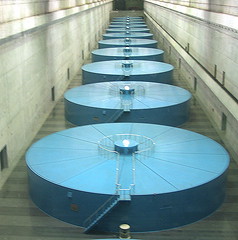
Hydroelectric turbines

Lights out across Venezuela


Earthquakes may be part of Venezuela's history, but of more immediate concern to most Venezuelans right now is the country's continuing energy crisis. The essential problem is that more than 70 percent of all the electricity in Venezuela is produced by the Guri Dam hydroelectric plant on the Orinoco River, the second- or third-largest hydroelectric complex in the world. An extended drought is making it diffiOur generatorcult for the Guri Dam facility to keep up with Venezuela's increasing demand for electricity, and other avaible powerplants only have the capacity to supply about 20 percent of the country's needs. The government has formally imposed rationing of electricity on the entire country, which for us means the power outages occur at more predictable intervals and for no more than three hours at a time. However, we do have our backup generator in place now.


Reblog this post [with Zemanta]